This site is managed by the Digital Inclusion Alliance Aotearoa (DIAA) and is intended for partner organisations delivering programmes endorsed and/or supported by DIAA. Currently this includes the following programmes:
Stepping UP
JUMP
DORA
Better Digital Futures for Seniors
Appy Seniors
Digital Wellbeing for All
The blog aims to address mainly operational issues associated with the delivery of these digital inclusion programmes. It provides a repository of information dealing with specific questions raised by programme delivery partners.
One of the things we discussed at our recent Partner Workshop in Auckland was to re-start periodic webinars for all Jump partners. Jump library partners in Auckland already have scheduled quarterly webinars, facilitated by the Whānau Learning team. So we have scheduled three timeslots during the week commencing 9 November for all other partners.
10am – 11am Tuesday 10 November
2pm-3pm Wednesday 11 November
11am-12 noon Thursday 12 November
Hopefully one of these works for you – you can register by clicking here. The format for each of these involves a “what’s new update” and an open floor Q&A. In the “what’s new” section we will cover the ImpactLab report “A Decade of Skinny Jump”and our Action Plan from the 14 October Skinny Jump Workshop.
On Wednesday 14th October, Spark hosted a 10-year anniversary celebration for Skinny Jump. We would have liked all our partners to join as you were really the ‘talk of the town’, but as there are about 1000 of you, even if we could afford it, there wouldn’t have been enough Air NZ seats to get you to Auckland. We were delighted that some of our Jump partners from Auckland were able to come as well as a couple of out-of-towners – see if you can spot them in this photo.
One of the highlights of the celebration was the launch of a new report prepared for Spark by ImpactLab: “A decade of Skinny Jump“. This report is a huge endorsement of your work as Skinny Jump partners.
The other highlight on Wednesday was a 2-hour workshop with representatives from 15 Jump delivery partners. We asked them to reality test some ideas we have for responding to the many great suggestions you provided in our recent partner survey.
We have now summarised their feedback into an action report – what we now have is an excellent roadmap for addressing some of the most persistent challenging issues that many of you face every day. Hopefully it won’t take the next 10 years to fully operationalise these ideas, but we are making an immediate start on things we can fix. So watch this space!
Some of the suggestions are outside our DIAA brief, but we have already raised some of these with the Skinny Jump Squad at Spark and we know they’ll do everything they can to progress them.
Some partners have recently been having problems when using the app to sign up new customers – for some reason this has been a particular issue with modems that have been delinked and should be ready for reissue. Please do not assume these modems are faulty.
We have now been advised that this problem affects signups on both Android and IoS phones and this has been escalated to the Mobile App team at Spark.
The error happens at Step 05 of 07:Connect a modem. After entering the Broadband number and modem verification code, customers get the “Something went wrong” error message.
To sign-up customers in the interim, please use the web browser option – (Chrome/Safari/Firefox/Edge).
Use the same email address and login password used when signing up via the Jump App (as this has already been registered)
Once successfully logged in, you will see an ‘Activate’ button – click that
Click the ‘Broadband’ tab next to ‘Mobile’
Enter in BB number and modem verification code
Success
The customer has now activated their service. Close down the app and reopen. Login using same email address and password used. The customer can then continue to use the app for top-ups and plan renewals.
An excellent question raised by one of our partners today. I know everyone expects pretty rapid responses to online orders – when purchasing something online, suppliers are very keen to (a) take your money and (b) get it on the courier. And courier services in New Zealand are really fantastic – overnight delivery usually means exactly that.
Sooo…how long should it take for Jump collateral to arrive when using the online order form? Our best estimate is 2-4 weeks and the Skinny Team has now added this as a “Please Note” to the order form.
Why so long you might be asking? For a start there isn’t an AI-driven machine on the end of the online form – this is the job for one of the Skinny Jump team to review and process. She aggregates the online orders every two weeks, and if the volume of requests are for reasonably large quantities, she then gets a quote from the printer which then has to be approved. She then places the order for printing. This can then take 2-3 days for processing and a further 3-5 days for shipping. More recently, request volumes have been relatively low, so orders can be further delayed; consolidating orders helps keep printing and shipping costs more efficient.
So my advice to all partners who need further collateral is to think ahead by at least a month, maybe 6 weeks to be on the safe side. Don’t wait until you have run out!
There are some items that we (DIAA) hold in stock, so an email request to jump@diaa.nz generally means we can get these on the courier the next day and they should be with you in less than 48 hours. This applies to:
(1) A4 Partner manuals – we do send one to every new Jump Specialist
(2) A6 Customer Guides – these are included with every modem, but partners should hold spares for modems that are delinked for reissue
(3) DL Stopped Using your Skinny Jump Modem stickers – these must be attached to every modem issued to remind customers to return their modems when they no longer need them
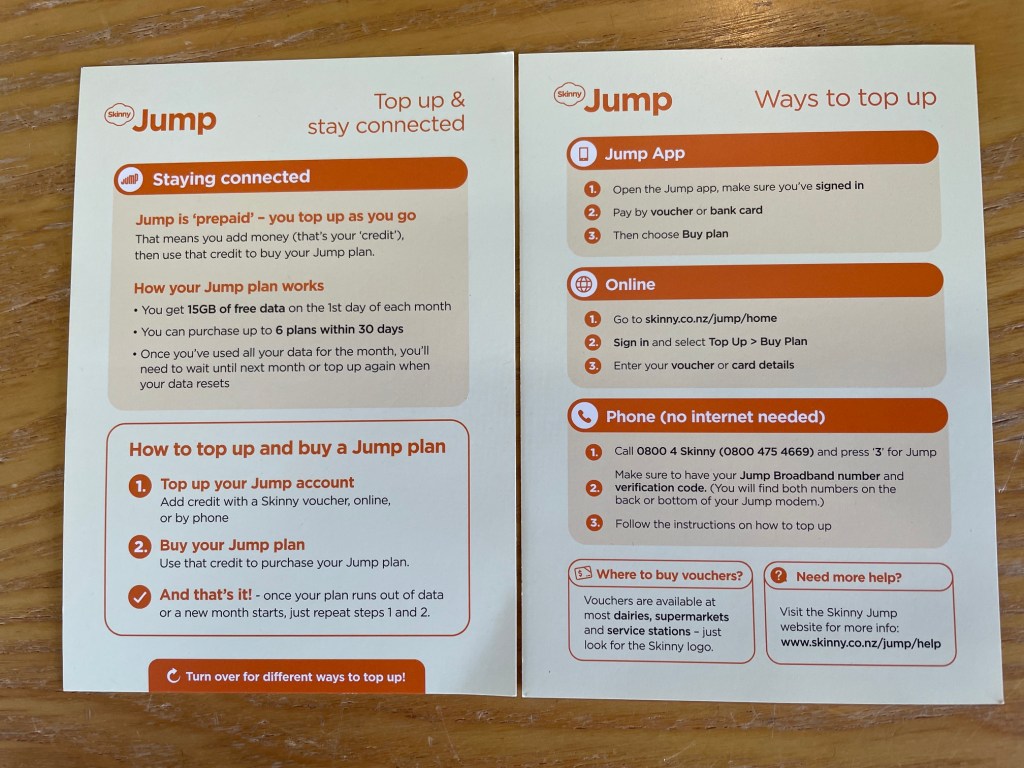
(4) A6 Top up & stay connected leaflet – these must be used to explain the top-up process to every new customer and then given to them as a reminder
Yesterday, I received 33 Modem Returns forms; six of these had been incorrectly classified by the person completing the form (Jump Partners and Skinny Care Team). This is not that unusual, which suggests to me that there are different ways to interpret these classifications, so I thought it worth explaining what difference this makes.
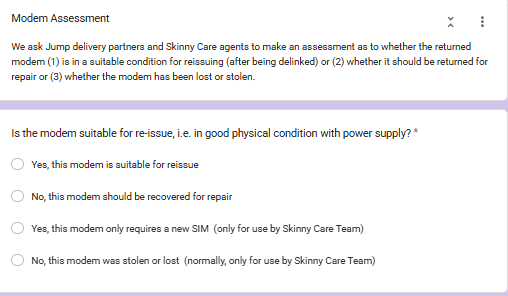
There are 4 options in the Modem Returns form for classifying a ‘returned’ modem; only the first two of these should be used by Jump Delivery Partners – the other two are additional options for the Skinny Care Team.
So what do each of these mean?
Yes, this modem is suitable for reissue
This is for situations where the customer no longer wants the Skinny Jump service. Partners are expected to make the call on the physical state of the modem, i.e. is it in a condition that means it would be suitable for reissue. This means the modem would be not be broken or physically defaced, nor would it be dirty. It would also have an installed SIM card and the person returning the modem would advise it is still in working condition.
If the modem has just been dropped off, it is worthwhile starting with the assumption it is suitable for reissue. Skinny Support will delink the modem from the customer’s email and reset the modem with 35GB start-up data, ready for reissue, or they will advise that the modem cannot be delinked and needs to be treated as faulty.
If there are missing parts, e.g. power supply, ethernet cable, customer guide, then DIAA can supply these on request – see my earlier blog post about this. Also my post about the different power supplies.
No, this modem should be recovered for repair
This option is to be selected when the returned modem is known to be faulty or is otherwise unsuitable for reissue. This includes obsolete B315 and B618 Huawei modems – all these are to be recovered for recycling.
Customers are expected to report all faulty issues to the Skinny Care Team and if the modem is assessed as faulty, the Care agents will complete a Modem Returns Form. This results in DIAA couriering a replacement directly to the customer, along with a recovery bag for the faulty unit. The Form is also used by the Skinny Support team to initiate the delinking process so that the customer can use their same email address in setting up a new account when the replacement modem arrives.
However, we know that some customers do not follow this procedure and simply turn up at a Partner expecting a replacement. We have also been unable to prevent some Care Agents advising customers to go to a local partner to get a replacement. In these cases, Partners have the discretion to issue replacement modems, but they must alert customers that they will not be able to set up a new Jump account using their existing email until the faulty unit is delinked – this can take 24-28 hours, but sometimes longer.
Yes, this modem only requires a new SIM(this option is only for use by the Skinny Care Team)
This option is to be selected when the Care Team determines that a simple SIM Swap will correct the fault. This generates a request to DIAA to initiate the agreed SIM Swap process, which results in a replacement SIM being couriered to the customer, together with instructions on how to activate the SIM Swap while retaining the same Broadband number (albeit with a different Verification Code). Jump Delivery Partners can not use this option if the modem has been returned to them – it must then be classified as faulty.
No, this modem was stolen or lost(this option should normally only be selected by the Skinny Care Team)
Our agreed procedures require all lost or stolen modems to be reported by the customer to the Skinny Care Team. They can verify the identity of the customer and arrange to block the lost/stolen modem as well as delink the customer’s account. If the customer requires a replacement, the Care Team will request DIAA to send a replacement by courier. By the time this arrives, the customer’s email will have been delinked, so they can proceed to set up a new account using their same email.
What should Partners do when a customer reports a lost/stolen modem to them?
They must direct the customer to contact the Skinny Care Team. Jump Partners must never issue a replacement modem unless customers can produce the faulty unit, which clearly they can’t do if the modem has been lost or stolen.
Nearly every day, I see modems being returned because “Jump doesn’t have enough data”.
One of the 6 C’s (“Capped”) that we expect partners to discuss with new customers is about the data cap (which is actually 225GB, when you take into account the free 15GB). And in particular to explain that Jump is a pre-pay top-up service where customers buy plans in bite-sized, affordable chunks ($5 for each 35GB).
So when I see a modem being returned after just a few days or even a few weeks, with the explanation of ‘not enough data’, I do wonder if they have set up their Skinny Jump account before leaving with the modem and if they really understand the top-up process. Or have they just used the free start-up 35GB data and decided that isn’t enough for them.
The Skinny Jump team produced a really helpful flyer explaining the top-up process and we expect that partners take the time to explain this two-step process (‘top up’ and ‘buy your plan’) to new customers. And to make sure that every customer takes home one of the flyers with them (suggest they stick it on the fridge as a reminder!).
If you have run out of these, remember you can always order more online here.
We understand that there are situations where 225GB really isn’t enough, e.g. for households with lots of teenagers or for people who watch hours of movies every day, and of course they are welcome to move to other services. But we do encourage all partners to have this conversation when modems are issued – Jump may not be the right product for them – this might prevent disappointment when they reach the cap.
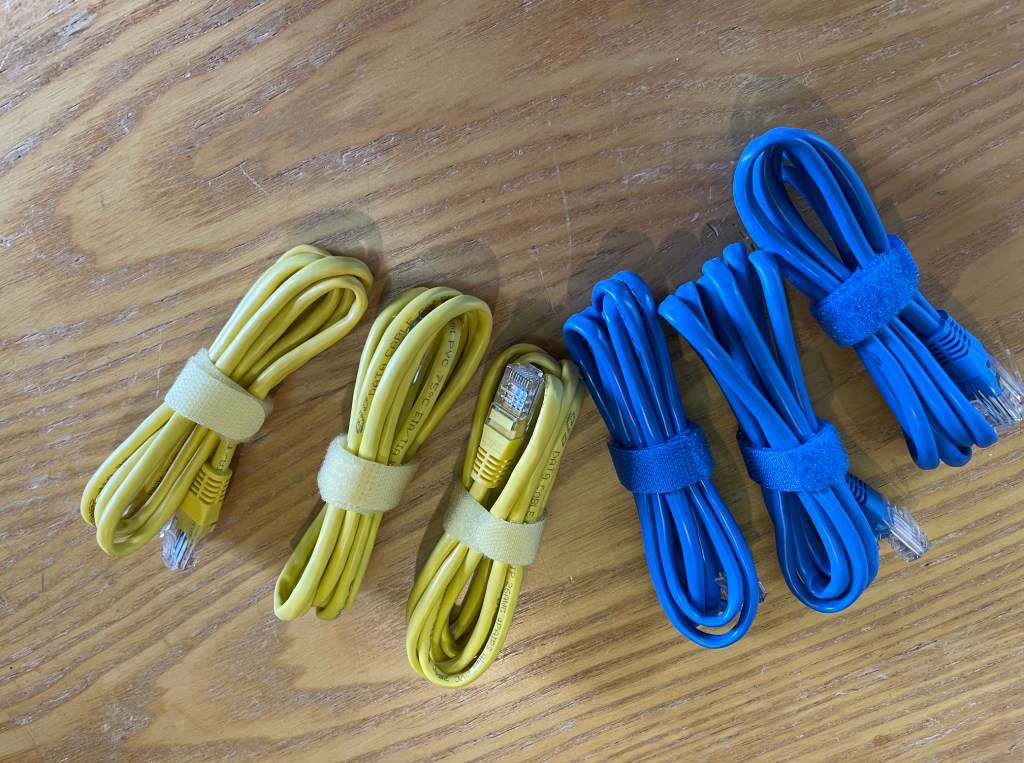
This is a question that is frequently asked by Jump partners. A returned modem doesn’t have its box or “wires”, so can I reissue it? It most cases ‘no wires’ means no ethernet cables (the yellow and blue ones).
The modems normally come with two short ethernet cables, but most Jump customers never need to use them. So what are they for? In the old days before WiFi was invented, people used these cables to connect their devices to the internet modem, but these days, WiFi is so good that you hardly ever need a cable connection. In fact most new devices like laptops no longer have an ethernet port, so there isn’t even a slot that you can plug these cables into.
So again, you are probably wondering why do we need this cable with a Jump modem. The answer is on page 27 of the customer guide (“How do I change my WiFi password?”). For this, we recommend you connect a computer to the Jump modem using one of the ethernet cables.
But then you might be wondering why are there two ethernet cables in every box. Well, this really has nothing to do with Jump. The same modems can be configured for fibre connections and you then need an ethernet cable to connect your modem to the fibre ONT (Optical Network Terminal).
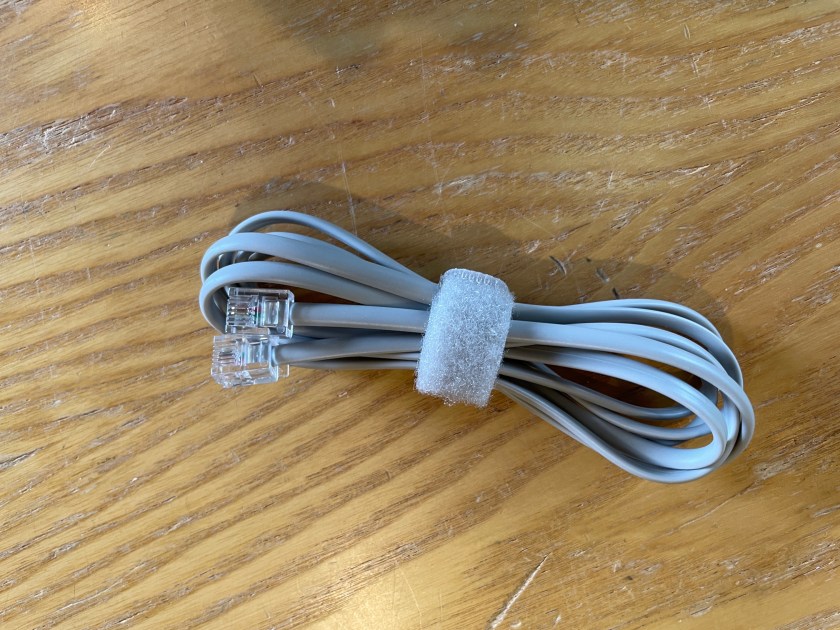
But to add further confusion, there is another cable in most Jump boxes – it is grey with telephone connectors and looks like the one in the photo below. This has nothing to do with modems configured for Jump, as unlike fibre connections, these don’t support telephone devices.
So, to cut a long story short, all you need with each modem is one ethernet cable and of course the power supply and user guide. We (DIAA) can supply spares if needed (just drop us a line at jump@diaa.nz).
But wait, there’s more – what about returned modems with no box? You are welcome to issue modems without boxes. We know that most Jump boxes are put in the recycling bin as soon as they are opened. Some library partners have bags for their customers to use in transporting books home and they use these for Jump modems. Others use one of the Jump “zero” bags – we can supply these on request.
As always, there is a moral to the story – let’s “reuse” Jump modems wherever possible and only return those that are faulty or obsolete.
A huge thank you to the 206 partners who responded to our survey. We have now consolidated the responses into a summary report and provided some comment on matters we are following up. We are also planning a Partner workshop in Auckland on 14 October to consider the many excellent suggestions put forward.
Some highlights from the report:
(1) 89% rated their overall satisfaction with 4 or 5 stars
(2) Many respondents were not using or aware of all the Jump resources available
(3) Email is the preferred and most effective communication channel for Jump updates
(4) Demand for printed collateral is low
(5) Many partners never access their Jump registers
(6) 95% rated their satisfaction with modem supply as 4 or 5 stars
(7) 68% rated their satisfaction with the modem return process as 4 or 5 stars, suggesting this is a particular area for improvement
From time to time customers return modems without their power supply and/or their ethernet cable. This does not necessarily make the modem faulty. We can supply spares if needed.
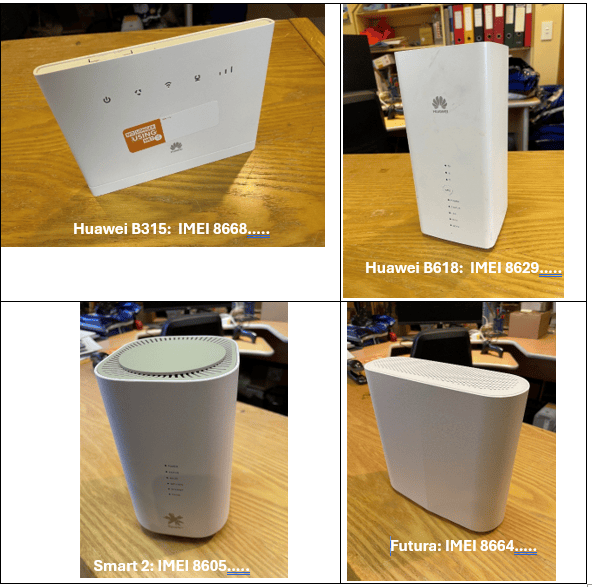
But what we do need to know is the IMEI number of the modem – or the type of modem, as the power supplies are different. Here’s a 1-minute refresher on the 4 types of modem used for Jump over the last 10 years.
First there was the Huawei B315 modem with a 1 Amp power supply, followed by the Huawei B618 modem with a 2 Amp supply. We consider both of these modems to now be obsolete, so when they become faulty we will recover them for recycling. But please note, there is no need to replace these modems if they are still working.
The third model to come along was the Smart Modem 2 and this uses a 3 Amp power supply. And our current Futura modem uses a 3.5 Amp supply.
We can also send spare ethernet cables; these are normally only required if customers want to change settings such as the WiFi password. We can also supply new copies of the User Guide.
When you need spares, please email jump@diaa.nz, providing the IMEI number of the modem (if a power supply is required) and any other parts needed.
We offer this option as a way to recognise Jump demand in congested 4G cell tower areas. We encourage customers to give us their contact details and permission to contact them if capacity becomes available. We don’t want to make promises about when we will do this; typically it would only be about monthly. If we do find the customer is now in coverage, we would contact them to check if they still wanted Jump and if so, get a modem on the courier.
From time to time we also aggregate all the ‘no coverage’ responses by location and share these addresses with the Spark network team. We expect that they will already be aware from their own information systems when a tower reaches capacity, as this triggers the ‘stop sell’ message on the Skinny Jump address checker (or ‘no coverage/capacity’ message, as we know it).
But they will not be aware of latent demand. So its’s good to wave this flag on behalf of potential Jump customers.
But regardless of what we are doing behind the scenes, we have no magic wand to upgrade capacity on cell towers; these are investment decisions that Spark alone manages. The good news is that Spark has has been investing an average of over $150 million each year on its mobile and 5G infrastructure and as wireless traffic moves to 5G, this frees up 4G capacity, i.e. more capacity for Skinny Jump.