A huge thank you to the 206 partners who responded to our survey. We have now consolidated the responses into a summary report and provided some comment on matters we are following up. We are also planning a Partner workshop in Auckland on 14 October to consider the many excellent suggestions put forward.
Some highlights from the report:
(1) 89% rated their overall satisfaction with 4 or 5 stars
(2) Many respondents were not using or aware of all the Jump resources available
(3) Email is the preferred and most effective communication channel for Jump updates
(4) Demand for printed collateral is low
(5) Many partners never access their Jump registers
(6) 95% rated their satisfaction with modem supply as 4 or 5 stars
(7) 68% rated their satisfaction with the modem return process as 4 or 5 stars, suggesting this is a particular area for improvement
Thank you to partners who make the extra effort to complete a Profile Form for customers who are unable to get Jump because of limited coverage or capacity on their cell tower.
We have just re-checked coverage for applications received in recent months and discovered 21 out of 42 now have coverage. 3 of these asked us to cancel their application if they were not in coverage, while 18 gave us approval to contact them should things change.
So that is what we have done this morning – sent 18 emails to these customers. Two bounced because of bad email addresses, but nothing much we can do about that.
This is the content of the email template that we used to send these messages:
Kia ora {{ First Name }} Good news! Your address now has Jump coverage. If you are still interested in this service, please contact your nearest Jump Delivery Partner – you can find nearby partners by typing your address into the Skinny Jump Address Checker. The details we have for your application on {{ Timestamp }} are:{{ First Name }} {{ Last Name }}{{ Street address (where Jump service is required) }}{{ Suburb }}{{ City or Town }} {{ Post Code }}E: {{ Email Address }}M: {{ Contact phone number }} Best wishes DIAA Jump Operations
So if someone turns up saying ‘Hey, I am now in coverage’, please sign them up. The partners involved with this mailout are listed below. When I work out how to include a cc copy in Mail Meteor, I’ll include relevant partners in future mailouts.
Pātea is famous for two things. One is world famous and the other, well, perhaps less famous outside Pātea.
Let’s start with the most famous thing – Poi E!—a groundbreaking Māori-language hit created in the early 1980s by the Pātea Māori Club. Written by Dalvanius Prime and performed by local community members, the song fused traditional Māori culture with contemporary pop and hip-hop influences at a time when te reo Māori was rarely heard in mainstream music. Its national success—topping the charts in 1984—helped revitalise pride in Māori language and identity, while also putting the small Taranaki town of Pātea firmly on the cultural map. Today, Poi E! remains an iconic symbol of grassroots creativity and cultural resurgence, and Pātea is closely associated with its enduring legacy.
Well that’s what everyone knows! What you might not know unless you live in Pātea is that for many years there has been no broadband capacity on the local cell tower. So much so that this has been Sue Kini’s reliable ‘go to’ place when explaining the ‘no coverage’ message that partners sometimes see when checking coverage for a Skinny Jump customer.
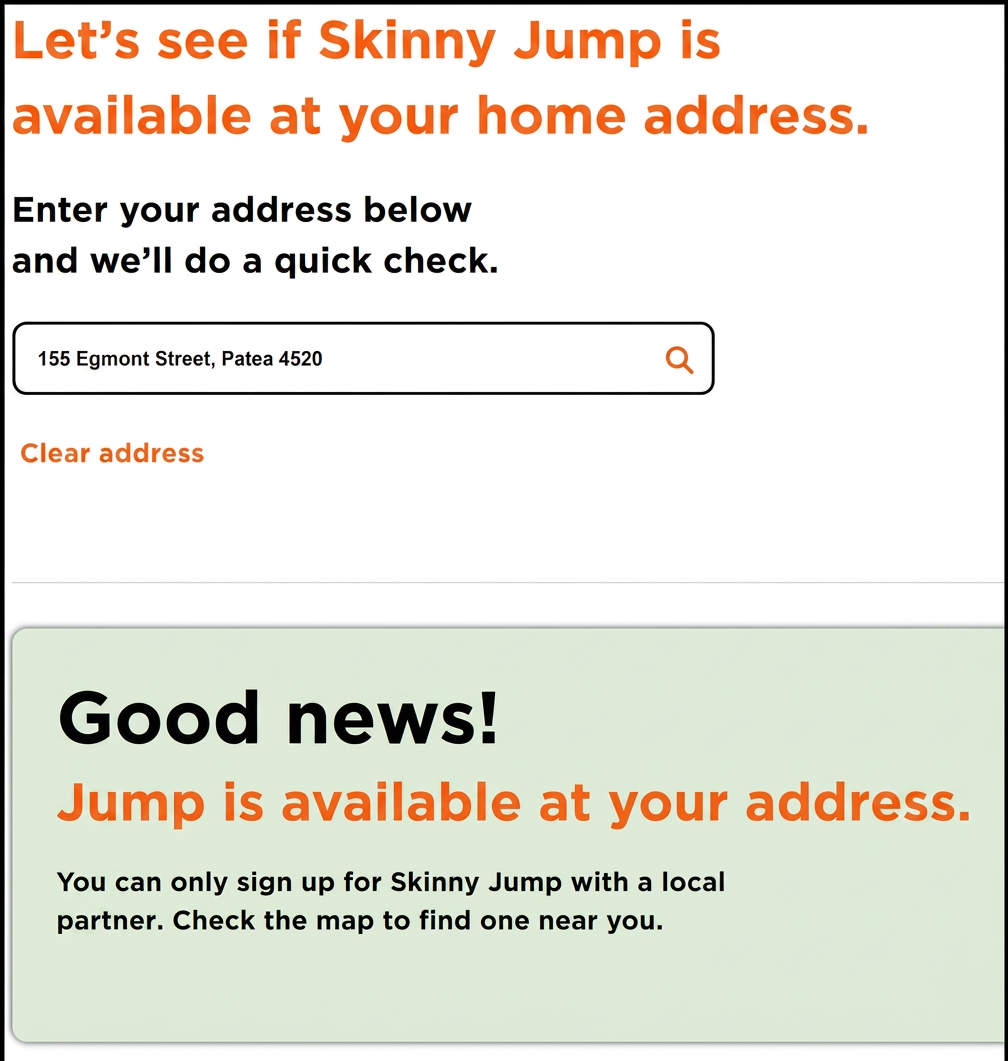
But last week this all changed and for the first time in many years the coverage checker returned this message for a Pātea address:
So of course the moral of this story is “never say never” when you have to say no to a potential Jump customer. Encourage them to check their address from time to time for coverage and they might receive a nice surprise. The address checker is updated every night, so things can change overnight, or as we have seen in Pātea, this can take some time.
PS for the Pātea LibraryPlus team: Can you remember the people you have had to turn down; perhaps let them know it might be worth checking their address again before the internet in Pātea becomes as popular as Poi e!
Duncan Philps from Onehunga Library asked this interesting question recently and it’s just possible that some other Jump partners might also have similar lingering thoughts.
Let me restate a few facts about this while answering Duncan’s question.
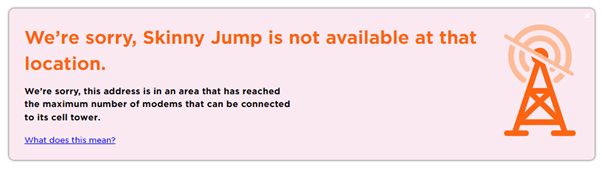
A customer contacts you and wants to sign up for Jump. What’s the first thing you do? Check their address has Jump coverage of course. And then you have to deal with a disappointed customer when you get this message:
FACT ONE: No coverage doesn’t necessarily mean ‘no coverage’: First thing to note is the small print, explaining what “No coverage” means. Nine times out of ten, it doesn’t actually mean there is no coverage, as the 4G network is very widespread and it is quite rare to discover a location with no wireless coverage. Most of the time it means that it is a capacity issue, i.e. the address is an area that has reached the maximum number of modems that can be connected to the nearest cell tower. The reason for capping the number of connections is to preserve an acceptable standard of service for existing customers; adding too many connections will degrade the service for everyone served from that tower.
FACT TWO: Cellphone towers radiate in three 120 degree sectors: Your customer might then want you to explain “how come then that my neighbour has coverage”, or “I tested my neighbour’s Jump modem in my house and it worked!” Click on the even smaller print in the “We’re sorry” message and you’ll end up here. You should also have copies of a DL pamphlet explaining cell tower coverage; you can find a link here to order more if you have run out.
FACT THREE: The Skinny Jump coverage checker is updated every night: The number of broadband customers connected to any cell tower can vary every day, so that a coverage check the next day or later in the same week could give the green light for a new connection. Customers can also move to other wireless service providers or a fibre connection, freeing up space on the Skinny tower.
FACT FOUR: For customers without coverage, completing an Online Application Form or a Profile Form does not guarantee a Jump connection: We introduced these options for partners primarily to help diffuse difficult situations with angry customers who cannot walk out the door with a Jump modem.
FACT FIVE: Capturing the details of ‘no coverage’ customers enables us (DIAA) to double-check coverage/capacity at the customer’s address: We do this when processing both the online applications and the profile forms. Sometimes we get a pleasant surprise and discover that capacity has become available and will contact the customer directly to see if they still want a Jump connection. But it is quite rare to get a positive result straight away. We check these addresses three to four weeks after receiving the ‘no coverage’ application and advise the customer by email of the result. We do not automatically do any further checks, which is why we advise customers to check themselves periodically, and many do this.
FACT SIX: Skinny does not contact Jump applicants who complete a ‘no coverage’ response on an Online Application or Jump Profile form when capacity becomes available: Skinny does not have access to individual customer information on either the Online Application of Jump Profile forms. The Skinny team uses the same address checker that we do.
FACT SEVEN: Capturing ‘no coverage’ addresses helps us inform Spark of Skinny Jump blackspots: We aggregate the data from the ‘no coverage’ responses to identify areas where there are many people waiting for Jump and share this data with Spark. That said, we have no influence on how Spark prioritises their investments in further 4G cell tower capacity. We know they have made significant investments in 5G infrastructure and we hope that as customers migrate to 5G, this will free up more 4G capacity for Jump.
PS: Duncan – I hope this addresses your questions.
I hope most Jump partners have discovered this for themselves by now. This was fixed late on Tuesday and all seems to be well. One little tip – I had to clear my cache before my browser would find the Jump site again.