Follow up to Jump 6 C’s Briefing on 20 September 2022

We ran out of time during Tuesday’s briefing to answer everyone’s questions, so I have compiled a Q & A below. This might also answer questions on other Jump partners’ minds. And remember it is not too late to register for one of these briefings – two more to go – at 9am on Thursday 22nd and 2pm on Friday 23rd. Register here.

Q: Can we please be sent the 6 C’s slides?

A: A copy of the slide deck will be added to the Partner Resources Hub for Skinny Jump on the Stepping UP website.  https://steppingup.nz/partner-resources-hub/skinny-jump-partner-resources/

Q: What about those that live in house buses etc?

A: This depends on how frequently the house bus is moved.  Skinny Jump customers may relocate their Jump modem to a new address provided they contact the Skinny Care team in advance to verify that there is coverage and capacity at the new location.  Customers who change address without notifying the Care team will have their service blocked.

Q: We have a person who travels around the district in her house bus with her jump modem. She comes in to us to check which possible locations have Jump available using Check my Address. So she shouldn’t have a modem?

A: Not necessarily. It is good that she is getting you to check addresses for coverage and capacity in advance, but unless she is also notifying the Skinny Care Team, she will appear in a breach report, which could lead to her service being blocked.

Q: Is anyone from Skinny Jump making contact with the inactive users or asking the partner that the user signed up with to try to contact them to discuss their inactivity?  This could increase the return of modems to be given to others.

A: Skinny is planning to introduce seven touch points (by email) during the first 12 months of each new Jump customer’s journey, to provide helpful tips and solicit feedback. This will identify any challenges that customers might be having with their Jump connection.

Q: Are all those points of contact digital?

A: At this stage, yes. By email.

Q: This might be better with a phone call as a lot of our JUMP people start a new email address just for JUMP. This is often because they don’t remember their password or have lost the phone so can’t reset it.

A: With over 1000 new customers every month, making contact by phone would be a huge task. We have tested phone follow-up but have discovered a large percentage have either changed their phone number or do not answer their phones.  Of the people who do answer, by far the majority are actively using the service. 

Q: A Skinny Jump customer recently told me that he saw that Skinny had a deal for unlimited data for anyone with a Skinny Mobile plan of $16 or more. He missed out on this deal but with 2 school aged children, he is finding that he is needing more data above the capped amount.  Are Skinny considering doing this deal again for those customers that also have a Skinny mobile plan?

A: Skinny, like other ISPs, does offer special deals from time to time to understand what works best for their customers.  The unlimited deal linked to Skinny mobile phones was a special 2-week promotion, but it is likely that there will be other promotions in the future.

Q: Is it possible to obtain a list of those in our churn rate so we can contact?

A: As a first step, Skinny is exploring the best way to share churn rates with Jump delivery partners and provide regular updates.  These will be added to partner GSheet registers when they are available. There are privacy issues in sharing individual customer churn details with delivery partners, although follow up support from partners would be welcomed.  We must first work out the best way to do this without breaching customers’ privacy.

Jump App Glitch being fixed

Last week, Leah from Chartwell Library in Hamilton encountered a problem during training with the Jump App using the library iPad. Things went fine to start with; she received the authentication code and entered a password. But when she tried to log into the account, she received the following error message:

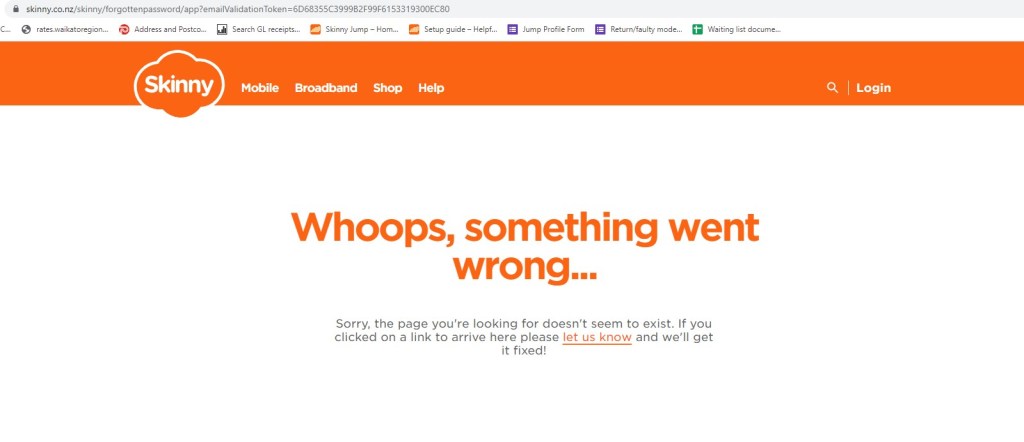
She then tried the “Forgot Password” link, but ended up with the following screen shot:

The Skinny Team ask Leah to confirm the device model (iPad Mini 5), the operating system on the iPad (15.7) and Jump App Version Number (1.0.6). Armed with this information the App developers were then able to replicate the problem and design a fix. Testing is now in progress, and an update will be loaded to the App Store later this week.

Thanks Leah, for providing such a clear explanation, that has allowed this glitch to be sorted. And thanks, Alan, from the Jump team, who followed this up so quickly.

Don’t miss out on the Jump 6 C’s

This morning, we held the first of five webinars with the Spark Foundation team to explain the 6 C’s. But don’t panic if you missed out – this webinar is being repeated at different times each day this week.

You will need to register on our Stepping UP website to get the link to the webinar. Click on the link above or go to our Stepping UP website > Join a Class > Select ‘Partner Webinars’ in the “All Categories” filter > Register for ‘Skinny Jump Service Updates’.

It is really important for all Jump partners to attend one of these 30-minute sessions to understand how you can help tackle the current modem shortage and improve the Jump experience for your customers.

Skinny Jump operates on a high trust model

A partner recently raised a concern about some customers who appear to be swapping their existing internet connection for a Jump connection (including some library staff), simply because it is cheaper; they felt this went against the spirit of the programme, especially at a time when we have a shortage of Jump modems.

Alan Bucheler, who is the Skinny Jump programme lead at the Spark Foundation, responded with an excellent explanation – I am repeating it below:

As the cost of living increases, we know that for some people paying for an internet connection may seem like a luxury they need to go without, so that they can still afford essentials like food, petrol or rent.  This is why Skinny Jump exists – so that anyone who finds that cost is a barrier to having an internet connection at home can still participate in an increasingly digital world. This is why we operate on a high trust model rather than income testing customers when signing them up to Skinny Jump –  to remove any barriers to people getting connected.  

Jump has a wide range of customers who include families with children, people living in social housing, seniors, refugees and new migrants, people with disabilities, and people on low incomes. Affordability looks different for everyone, which means that some library staff and their households could meet the Skinny Jump eligibility criteria. 

Jump is capped at 210GB a month, which allows customers to do the essentials – like applying for jobs, online learning, banking and emails. However, 210GB is not enough data for streaming services or gaming, and we believe that this data cap acts as a deterrent for customers who are just looking for a cheaper deal on an internet connection. Skinny has a number of commercial plans in market for customers looking for low-cost internet options, that might better suit their needs.” 

When are more modems arriving?

This continues to be the ‘most asked’ question by Jump delivery partners. We publish everything we know on your Jump registers, so we would like to encourage you to check this out before asking.

We have also recently updated the presentation of information in your GDocs to make things a bit clearer, but of course you do need to know where to look. So many numbers and colours! I understand how this can be confusing.

The numbers you need to take note of:

Cell G2: this is your trigger level for the supply of further modems. This changes dynamically, depending on the number of modems you are issuing; it currently mirrors the number of modems you have issued during the last six weeks, although we have a pre-set minimum level of 2 modems for partners with low turnovers.

Cell H2: This is a ‘virtual’ stock count. It takes into account the number of modems you are physically holding plus the ones we have on order for you minus the number on your waiting list. This is why waiting lists are so important as they help us take into account the latent demand when re-ordering for you. Make sure you use the following date format when adding people to your waitlist, which can be anywhere below the fields with IMEI numbers: 6-Sep-2022 (and make sure is is ‘Sep’ for September, not ‘Sept’).

Cell W2: This is the actual physical stock that we think you have. If this doesn’t align with reality, please let us know so that we can fix things. The most common cause of our numbers getting out of sync with your reality is when modems are issued without a Profile Form being completed.

Cell X2: This is the number of modems currently on order for you. We place an order for you as soon as you reach your trigger point. You can scroll down column X in your Jump register and find out the date that we placed the order. This when the 6-week countdown starts until they physically arrive at arrive your premises. While they are only being couriered from Auckland, the delay is being caused up the supply chain, all the way back to the manufacturer in China.

Columns Y and Z: Scroll down to see the yellow highlighted fields. These record the NZ Post courier tracker number and the the date of your shipment. Modems generally arrive within 1 or 2 days of this date.

The other thing we often get asked about are the mysterious truncated IMEI numbers, e. 860501, 860502, etc. These are temporary numbers to indicate that modems are on order; they get replaced with the full 15-digit IMEI numbers when we receive the shipping report from the Auckland supplier. We usually experience a couple of days delay after shipping before we get the reports, which generally means the modems arrive with you before we update the GDocs.

Jump modem waiting lists

We are hearing that many partners have taken our advice and have implemented a local waiting list for customers wanting a Jump modem. We would like you to share this with us – just a short email to jump@diaa.nz would help but we have an even better idea. Read on!

We have been trying for the last month or so to target shipments to partners with high turnovers by dynamically adjusting the modem re-supply trigger level. Originally this was based on the number of modems issued during the last 3 weeks, but to try and address the waiting list situation, we have progressively extended the trigger period to 6 weeks. The objective is to ensure partners have enough stock to cover the wait time for new stock (which has now escalated to over 6 weeks).

However, this was based on the assumption that there was no waitlist. Clearly, if partners have no modems, they can’t issue them and therefore it does not truly represent actual demand.

So our cunning plan is to now include your actual waitlist in the calculations. What we would like you to do is record the names of people on your waitlist in your GDoc. Enter their first and last names (columns B & C) immediately underneath the lines with IMEI numbers and the date they joined your waiting list (column E). As modems are allocated to them and profile forms completed we will transfer them from the waiting list to the active customer list.

We know this won’t solve the modem supply chain delays – that is way outside our control – but it might help to further reduce buffer stocks and help get modems to the partners that need them the most.

We also appreciated the pro-active offer from one of our partners who were happy to relocate their slow-moving stock to another partner. We immediately sent them a courier sticker to action the offer.

We also know that some partners with multiple libraries are moving stock between their venues to try and address shortages. We totally endorse this approach, with one provisio, that you send us an email (jump@diaa.nz) advising the source and destination locations and the IMEI numbers of the modems being transferred.

Modem returns from Customers who are not in JUMP coverage

I have been advised this week by partners of two instances where customers are seeking replacement modems but their addresses now fail the Skinny Jump address coverage check.

My advice in both instances has been to provide a replacement modem.

Jump coverage and tower capacity is something that is changing all the time and while we are not permitted to connect new customers at addresses that fail the coverage check, we must give priority to existing customers in replacing faulty modems.

One partner raised a concern that the customer involved could have changed addresses since they were originally connected two years ago. We (DIAA) do not hold records of customer addresses in situations where modems have been issued by partners, so we have no way of checking. The other situation involved the transfer of a modem within the family at the same address.

Our recommended approach is to remind customers that they must always check with the Skinny Care Team (0800 475 4669) before relocating their modems to a new address, but if customers advise that they are at the same address as the one they used when originally connecting to Skinny Jump, then we have to take that at face value and provide whatever assistance we can to keep their connections active.

Customers should be advised that in areas that have reached capacity, the performance of their connections might not meet the standard expected of a broadband service and if they were unhappy with the performance of the replacement modem, they should return it (with packaging) and seek an alternative service.

New process for faulty Jump modems to start on 15 August 2022

We reached agreement with the Skinny Jump team today to proceed in implementing a new process for handling faulty modem replacements. This is an attempt to address the continuing shortage of modems and the re-supply waiting time that has now stretched to 6 weeks.

It has also been prompted by the difficult situation that partners are facing when the Skinny Care Team (Helpdesk) refer a customer to you for a replacement modem, but you are unable to help because your Jump modem cupboard is bare.

What is changing from 15 August is that all replacement modems for faulty units will be supplied from our DIAA Wellington office.

We hold a small stock of modems for customers who are unable to travel to a local Jump partner or when local partners are closed. Now that most partners are open again after the Covid restrictions, our priority will be to support existing customers who need replacement modems.

Jump customers must continue to contact the Skinny Care Team first (0800 475 4669) whenever they are having trouble with their Jump internet connection. This is not changing.

If the Care Team diagnose the problem as a modem fault, and the customer advises that they wish to continue with the Jump service, the Care Team will complete a Modem Return Form with the customer’s contact details (address, email and phone) as well as details of the faulty modem (IMEI and broadband numbers) and a brief description of the fault.

This will the ensure that: (a) the faulty modem is delinked from the customer’s account, so that customers can use the same emails to set up replacement modems and transfer any credit balances, and (b) replacement modems are couriered to customers along with a pre-paid bag to recover faulty modems for repair or recycling.

What this means (at least in theory) is that partners should never have to issue replacements for faulty modems. Customers who do not require a replacement will continue to be encouraged to return their modems to a nearby partner, where partners will be responsible for completing a Modem Return form, as you currently do.

We know that some customers will just turn up with faulty modems, seeking a replacement. If partners have supplies of modems, you are welcome to provide the replacement, noting details on the Modem Return Form. But clearly if you don’t have any stock, your only option is to refer customers to the new process outlined above.

“Just wondering why the stock levels don’t update”

A Jump partner recently sent me a note wondering why the stock levels didn’t update in his Jump Register after he had submitted a couple of Profile Forms.

I was pleased to receive this message because it confirmed that this partner was (a) completing profile forms; and (b) monitoring their Jump register to ensure that the GSheet record aligned with the actual number of modems they were holding.

I suspect his question arose from a misunderstanding about our back-end processes, which in all fairness, we have probably never explained. It’s all about timings.

Alistair schedules this activity into his daily calendar, and on most days, completes everything the same day, but he doesn’t work at the speed of light (like a computer does), so this means it could be up to 24 hours before the updates take effect.

The Profile Form is a Google Form that automatically populates a Google Sheet.

Alistair, one of our DIAA team, works diligently every day transferring selected information from the Jump Profile GSheet to individual Partner Jump registers. This then updates partners’ stock counts. If this triggers a re-order alert, Alistair then places an order for the supply of more modems.

Alistair also drives DORA, our mobile learning centre, and on days when he is moving the bus, he might not get to do the updates until the next day. But he never lets us down and in that sense he is undoubtedly more reliable than a computer.

Confusion about when to order Jump modems online

When two or more partners ask the same question, then it is time for me to post to this blog.

The modem shortage is causing some new issues; we currently have over 900 on order, and it will take at least 3-4 weeks to catch up, by which time we expect to have another 900 on order. As a result of this delay, partners have asked if they should use the home delivery process when they run out of modems.

Our short answer is no! We prefer that you create a waiting list – one partner this week advised us that they have a waiting list of 27! The modems we use for home deliveries come from the same supply pool as that used for partners and our priority for the online pool is for customers who cannot get to a local partner to collect a modem and for replacing faulty modems.

Our guideline for home delivery orders is that partners should only use this for customers who for some reason can not go to a local Jump partner.  We much prefer that they come to a local delivery partner where you can give them help to set up their accounts and make sure they know about the Jump app. 

However, we do encourage you to lodge an online application for people who do not have coverage or are in areas where there is no Jump capacity.  We do double-check that there is in fact no service at this address, but mainly we use this to keep Skinny updated on unsatisfied demand.

So when it is just a case of modem shortages, we encourage you to keep a waiting list, and get back in touch with your customers when further stocks of modems arrive.