“No Coverage” – What happens next?

Duncan Philps from Onehunga Library asked this interesting question recently and it’s just possible that some other Jump partners might also have similar lingering thoughts.

Let me restate a few facts about this while answering Duncan’s question.

A customer contacts you and wants to sign up for Jump. What’s the first thing you do? Check their address has Jump coverage of course. And then you have to deal with a disappointed customer when you get this message:
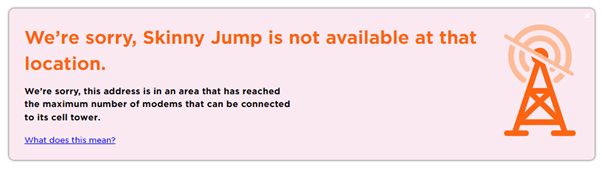
FACT ONE: No coverage doesn’t necessarily mean ‘no coverage’: First thing to note is the small print, explaining what “No coverage” means. Nine times out of ten, it doesn’t actually mean there is no coverage, as the 4G network is very widespread and it is quite rare to discover a location with no wireless coverage. Most of the time it means that it is a capacity issue, i.e. the address is an area that has reached the maximum number of modems that can be connected to the nearest cell tower. The reason for capping the number of connections is to preserve an acceptable standard of service for existing customers; adding too many connections will degrade the service for everyone served from that tower.

FACT TWO: Cellphone towers radiate in three 120 degree sectors: Your customer might then want you to explain “how come then that my neighbour has coverage”, or “I tested my neighbour’s Jump modem in my house and it worked!” Click on the even smaller print in the “We’re sorry” message and you’ll end up here. You should also have copies of a DL pamphlet explaining cell tower coverage; you can find a link here to order more if you have run out.

FACT THREE: The Skinny Jump coverage checker is updated every night: The number of broadband customers connected to any cell tower can vary every day, so that a coverage check the next day or later in the same week could give the green light for a new connection. Customers can also move to other wireless service providers or a fibre connection, freeing up space on the Skinny tower.

FACT FOUR: For customers without coverage, completing an Online Application Form or a Profile Form does not guarantee a Jump connection: We introduced these options for partners primarily to help diffuse difficult situations with angry customers who cannot walk out the door with a Jump modem.

FACT FIVE: Capturing the details of ‘no coverage’ customers enables us (DIAA) to double-check coverage/capacity at the customer’s address: We do this when processing both the online applications and the profile forms. Sometimes we get a pleasant surprise and discover that capacity has become available and will contact the customer directly to see if they still want a Jump connection. But it is quite rare to get a positive result straight away. We check these addresses three to four weeks after receiving the ‘no coverage’ application and advise the customer by email of the result. We do not automatically do any further checks, which is why we advise customers to check themselves periodically, and many do this.

FACT SIX: Skinny does not contact Jump applicants who complete a ‘no coverage’ response on an Online Application or Jump Profile form when capacity becomes available: Skinny does not have access to individual customer information on either the Online Application of Jump Profile forms. The Skinny team uses the same address checker that we do.

FACT SEVEN: Capturing ‘no coverage’ addresses helps us inform Spark of Skinny Jump blackspots: We aggregate the data from the ‘no coverage’ responses to identify areas where there are many people waiting for Jump and share this data with Spark. That said, we have no influence on how Spark prioritises their investments in further 4G cell tower capacity. We know they have made significant investments in 5G infrastructure and we hope that as customers migrate to 5G, this will free up more 4G capacity for Jump.

PS: Duncan – I hope this addresses your questions.
Jump Modem Returns – Why does the Skinny Care Team keep referring customers to partners?

William Chou from Te Manawa Library in Auckland has recently raised this question and to be fair, he isn’t the first one to do so.

William advised us that there had been at least three instances at Te Manawa during the last two months where the Skinny Care agents had advised customers reporting a faulty Jump modem to go to the library, “as it would be faster”. But as William pointed out, this conflicts with my previous posts (and as it happens, the Jump Partner Guide).

Here’s an extract from my April 2025 post:

It seems that part of the confusion arises when Skinny Care agents mistakenly direct customers to Jump partners for replacements. Please note: Skinny agents should never refer customers to partners for replacement modems. If they confirm the modem is faulty, they should complete the Modem Returns form instead.

So William is quite right to question whether our processes have changed.

The short answer is that our agreed processes have not changed. The challenge that we seem to have is training new Skinny Care agents. The agents are dealing with both regular Skinny products and Skinny Jump, and we do have quite a lot of unique procedures for Jump, especially around the distribution and return of modems, and are regularly making tweaks to Jump processes. I can understand that this could be quite a challenge for Care Agents to keep up to date with.

I know the Jump Squad in Spark provide regular updates and training for Care Agents and all they can really do is keep issuing reminders of the correct procedures.

But we also know that some Jump partners are happy to issue replacement modems. There are problems in doing this, especially around timings for delinking the faulty modems from customers’ accounts. So despite the instructions in the User Guide (does anyone read user guides these days???), customers will keep coming to partners for faulty replacements.

But we want this to be your choice, not feeling that others, e.g. Care Team, are handing on work onto you that they should be dealing with.

How do we fix this? Frankly, I don’t know. Maybe persistence? So please keep alerting me (jump@diaa.nz) to any instances where customers are saying “Skinny told me to come to you for a replacement modem“. In a perfect world it would be great to know the name of the Agent providing this wrong advice, or as a minimum, the day and time of the call.

Jump modem supplies flowing smoothly

More good news for 2026! First, there was the announcement that Ciena has extended their sponsorship for another 350 families and now CEVA, the supplier of Jump modems, is shipping modems within days of our orders being placed. This is a fantastic improvement compared to last year, when modem shipments were often lagging by 6-8 weeks.

As the delivery lag reduces, we change the trigger level for new orders; towards the end of 2025, this was set to the number of modems issued by each partner during the previous 30 days. The goal was to ensure that partners had sufficient stock for at least 30 days.

But, like the Reserve Bank’s official cash rate (OCR), we can adjust the trigger level to reflect changes in the Jump economy. So thanks to Marian Hector at Glen Eden Library, who noticed the impact of the 30 day rule meant her Jump modem stock levels are now persistently much higher. Not that she was complaining, but some partners might find this puts more pressure on their storage spaces.

So, like the Reserve Bank Governor does with the OCR, I am please to announce that as from today, the OJR (Official Jump Rate) has been reduced to 14 days.

Well, this certainly wins the Jump creative award for 2025!

Now the challenge is to spot what the following two pictures have to do with Jump!

Here’s a hint. She works in a library. She is famous for many things, not least of all is her creativity. She has exhibited at Te Papa! She features regularly in local and international media. She has the enviable position of Digital Inclusion Coordinator | Kaikōtuitui, Mātau Matihiko in her North Island Library. Now, wouldn’t just every library love to have one of those!

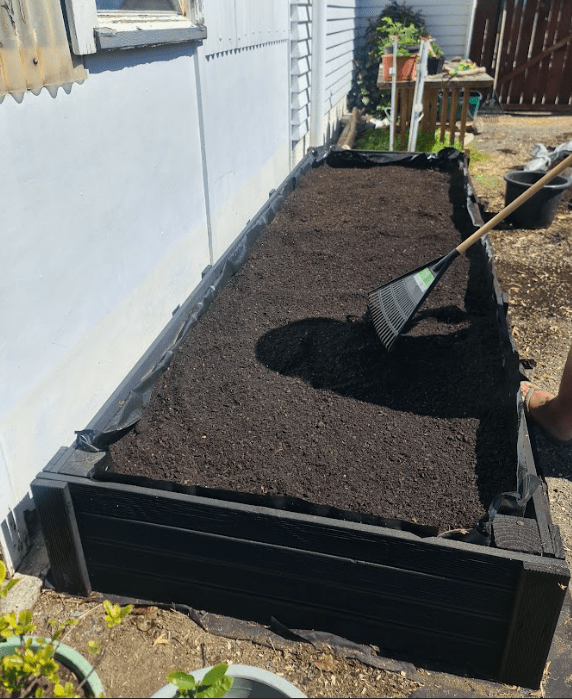
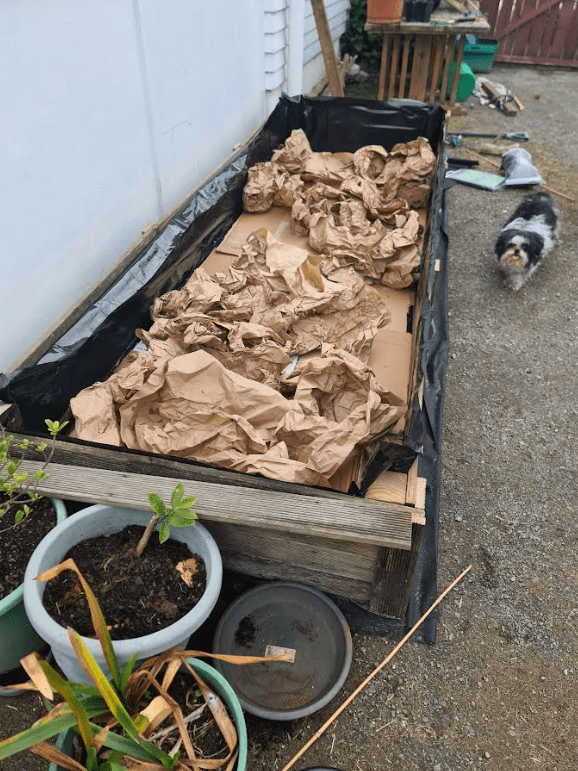
She says: I just wanted to share that I love Skinny JUMP modem time because I love reusing the boxes and the packaging! Our last delivery was in September and I used the boxes and the packing paper to help fill a brand-new garden bed that I was creating on my driveway. I am now eagerly considering a new garden box to stuff my latest round of Skinny JUMP boxes and packing paper into! 

She is the one and only Leala Faleseuga!!

Watch out sustainable awards – here she comes – reduce, reuse , recycle!!

Why do I need to complete a Jump Profile Form?

I received an email from a partner yesterday who had just completed a mini stock-take and discovered 3 modems listed on their GSheet that they no longer had. He thought this was probably because Profile Forms had not been completed by some staff members when the modems were issued.

So this led him to ask was: “what is the impact of us not completing the profile form?” He wanted a compelling reason to explain to staff issuing modems why this is important. Fair enough, I thought.

Sure, we ask for a lot of demographic information – this is used in our annual report to programme funders, providing evidence that the modems are reaching the target groups. But that is not the most important thing.

We ask for the address where the modem is going to be used, so that we can avoid issuing more than one modem to the same household. But that is not the most important thing either.

We also use the address information to provide summary reports by town and region to provide evidence that Jump is reaching the most digitally disadvantaged communities. But that is not the most important thing either.

We ask customers to tell us who is helping them set up their Jump modems. We think the support provided by libraries and local community partners is absolutely critical to the ongoing success of Jump, and this helps provide the evidence. But this is not the most important thing either.

We ask customers if they have school-aged children and therefore qualify for free internet connections with programmes like Ciena. But that is not the most important thing either.

We ask for the phone contact details of the customer and their explicit approval for any follow up calls to get feedback on how Jump is helping them. But that is not the most important thing either.

OK, enough, I hear you cry! What then is the most compelling reason for completing a Skinny Jump Profile Modem??

Quite simply, so that we know when to send you more modems!

We (DIAA) manage the modem supply process for Jump, and for probably rather obvious reasons, we do not have access to Skinny’s customer database. So we rely on the Profile Form to update us on the modems being issued. We closely monitor all partners’ stock levels and each week, prioritise deliveries to those with low stock. So if partners issue a modem without completing a Profile Form, we think you still have this modem, and you move down the re-order priorities.

We strongly recommend that all partners periodically do a stock check and confirm that the number of modems they actually have aligns with the number in cell E2 (Actual Stock on hand) of your Jump GSheet.

If there is a mismatch please send a schedule of the IMEI numbers of the modems you are holding to jump@diaa.nz and we will update your GSheet accordingly.

The good news for the partner who raised this issue was that when his Gsheet was corrected, it immediately flagged the need for a new order, which we have actioned.

Chat GPT drops the ball! But Tim comes to the rescue.

Tim Edmonds, one of our Digi-Coaches based at Kapiti District Libraries, has given us a timely reminder that GPT doesn’t have all the answers to life, certainly when it comes to data analytics!

We have been trying to present our Jump stats by local and regional authority area, but have been struggling to find a look up table that groups NZ towns and cities into these regions. I thought this would be an excellent job for Chat GPT. Chat GPT helpfully identified StatsNZ as a source of data (something I sort of already knew), and directed me to some stats tables that might have been useful if I had the skills to navigate them, but after numerous frustrating attempts I failed to get the output I needed.

So with nearly 50 Digi-Coaches now working in libraries in Northland, Waikato, Central North Island, Wellington and the Top of the South Island, I threw out this challenge to them and Tim came up with the goods, in less than an hour, he said.

His solution was not to use Chat GPT, nor Claude, nor Gemini, nor Co-Pilot, but a proprietary tool called ArcGIS Pro, something he was familiar with as an Insights Data Analyst in a previous life.

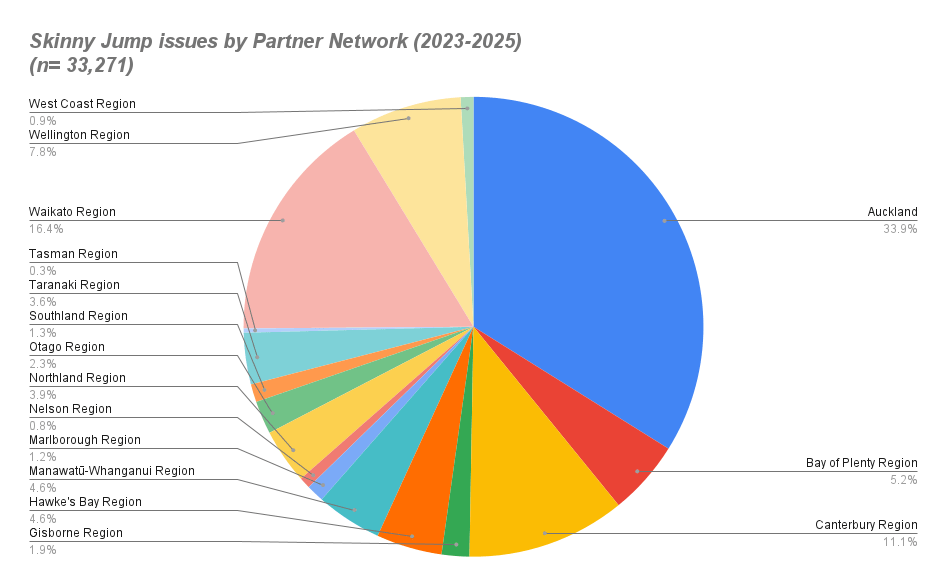
So what are the results? Here’s a taster. Probably not a lot of surprises. We are planning to develop this a bit further – we are missing 10% of all issues in smaller towns and this also doesn’t include the online orders (another 10%). So with Tim’s help, we plan to add these to the pot and also do a sort by TLAs (Councils).

Are you an avid follower of fashion?

This message is for all ‘avid followers’, not actually ‘fashion’ in this case but Jump Partner GSheets. I know these are not everyone’s cup of tea, but they do play a critical role in our efforts to ensure a smooth flow of modems.

I know that at least one of you is such an avid follower of Jump GSheets that if her one is not updated with any new modem issues by the time she arrives at work each day, she is firing off an email, wondering if there has been a mistake.

Now that was the day (nearly a year ago) when there was an Alistair, who made a point of starting his day at 5am by updating everyone’s Gsheet (transferring the Profile Form data to partner Gsheets). We thought we might have an AI replacement for Alistair by now, but sadly not. Instead we have Tori (Talented, Outstanding, Resourceful and Industrious), who is not an AI engine but a very talented and competent student. Unfortunately, she still at school, and can only work for us on Saturdays.

So this means the Jump Profile data only gets transferred to partner GSheets on Saturdays. But all is well, this is in time to shuffle order priorities for the next week’s orders, which are processed every Thursday.

Jump modem orders: next week’s deliveries

As I have mentioned before, the most common question from partners is “when am I getting more modems?”. I thought it might be helpful to share the current order processing list with partners, so that you have some idea about when to expect further supplies.

The following modem orders have been sent today to CEVA for processing. This means that you can expect these to be delivered next week. Orders for another 100 partners have still pending, so if you are not on this list, then further supplies are at least two weeks away.

With Christmas coming soon, I’ll have a go at connecting this information to individual partner Gsheets, so that this “in processing” data is displayed dynamically.

18St Andrews Library
18Te Takeretanga o Kura-hau-po Levin
6Naenae Community Library
6Raglan Community House
18Dinsdale Library
12Ashburton Library
18Elma Turner Library
12Kerikeri Procter Library
18Northcote Library
6Mangere Bridge Library
6RaWiri Residents Association
6Ngaruawahia Community House
6Te Ahurei a Rangatahi
6Southern REAP Gore
6Tairua Library
6Mangakino Central Charitable Trust
12Ranui Library
24Te Paataka Koorero O Takaanini
6Pakuranga Library
12Fendalton Library
6Leys Institute Little Library
6Stratford Library
6Hawera LibraryPlus
12Tupu Youth Library Otara
12Wairoa Library
24Otara Library
18Avondale Library
12Glen Innes Library
12Dannevirke Library
12Opotiki Library
12Whangarei Central Library
18Papakura Library
18Rotorua Library
12Manurewa Library
12Te Paataka Koorero o Waimaahia (Clendon)
6Waitara Library

And someone else who needs a prize, Digi-Coach Jylesza Needham

Jylesza is one of our fabulous new Digi-Coaches who are emerging in many of our Jump partner organisations. She is based at Elma Turner Nelson Public Library.

All our Digi-Coaches are trained to become Jump Specialists, so they can hit the ground running when they start their work placements. On her first day, Jylesza got a hug from a customer, as an expression of appreciation for the help she had provided. Maybe our long-term Jump partners have just got so used to getting hugs from their Jump customers that they don’t see it as ‘news’ any more!

Jylesza as well as some other partners have also asked for clarification about the ‘rules’ around Jump partners issuing modems to customers who live outside the partner’s area or region. For example, it could be someone who has tried to sign up for Jump at their local partner, but discovered they have no modems, so they ‘shop around’ to find a partner with stock, or they could simply be moving to a new area.

It goes without saying that they must satisfy the Jump coverage check for the location where they intend to use the modem, but there are no rules that restrict where they can sign up. A bit like McDonalds, you can get a Big Mac from any outlet, not just the one in your own community.

Where the uncertainty sometime arises is for library partners, who have territorial rules about who can sign up for a library card and borrow books.

Jump, however is different. While we often use the library analogy for Jump, where you get something for free and when you don’t need it anymore, you return it, but we don’t restrict where people can sign up.

One thing we do discourage is for partners who have run out of stock to direct customers to other Jump partners unless they know the other partner has stock and is happy to accept referrals. We prefer that you use your waiting list (below the blue line in your GSheet). This also helps us boost the number of modems in your next shipment.

So, thank you Jylesza for asking the question and congratulations on your first customer hug!

Martha wins the Prize!

Our hats off to Martha Manaena at REAP Wairarapa for bringing to our notice an interesting anomoly. She was trying to issue a new Jump modem and discovered it had the same IMEI number as one she had issued some time ago. To make matters worse, the modem had no Broadband sticker!

After a quick look in the box, she discovered the wayward broadband sticker attached to the inside of the box as many others have done during the last six months – this happens when the modems are thrust into the box too forcefully and the transparent broadband sticker decides to attach itself to the side of the box – remember, I raised this issue some months ago.

But modems with the same IMEI number??? This was news to me until I put on my thinking cap. Of course there would be modems with the same IMEI number. We have been using refurbished modems for the last 6 months and of course, a refurbished modem will have the same IMEI number as one that has been previously issued. The IMEI number is assigned by the manufacturer and relates to the modem hardware, not the Skinny internet connection.

There’s always a ‘good news’ side to the story. The IMEI number is something that we (DIAA) use to monitor modem supplies, but this is not relevant to Skinny – they rely on the Broadband number and Verification code, the two bits of information on the troublesome transparent sticker that sometime detaches itself.

So well done, Martha, for being the first person to notice this apparent anomoly, or at least the first person to raise it with me!