Toy Libraries are not eligible for Jump

We regularly receive inquiries about whether community groups such as toy libraries, scout groups, rowing clubs etc. are eligible for Skinny Jump. I can understand that a low cost pre-pay service such as Jump would suit the needs of many community groups, who only require internet access from time to time.

But Jump is a highly subsidised service supported by the Spark Foundation and intended for households that can not afford monthly ‘on account’ internet plans. Eligible groups are clearly identified in Jump promotional material as well as on the Skinny Jump website.

Partners are asked to explain this to any community groups that might apply. We have heard stories from some partners that community groups can be quite argumentative when they are turned down, claiming that other similar groups are using Jump connections. If this is the case, a mistake had been made in issuing modems.

We suggest you ask for details of groups who are claiming to have been provided with Jump modems and by whom so that we can correct this misinformation.

Don’t call Skinny for modem supply issues

I have been receiving a few redirected calls from the Skinny Care team with requests from partners about modem supplies.

PLEASE DO NOT CALL THE SKINNY CARE TEAM FOR ANY DETAILS ABOUT MODEM SUPPLIES.

The Skinny Care team has no role in the supply of modems. This is our (DIAA) responsibility, working with you, our Partners.

Any inquiries about modem supplies should come to jump@diaa.nz

Thank you.

“I am down to my last Jump modem; when will more supplies arrive?”

This is one of the most frequent questions that we get asked. We do try to respond promptly to individual requests, but with over 300 delivery partners, we do get a bit swamped at times with email and phone requests.

You have access to the same information that we do, so we would like to encourage you to check this out first.

Let me remind you how to do this:

(1) Go to the GSheet Jump register for your organisation. You may need a Gmail account to do this. If you don’t know how to access this, send us an email (jump@diaa.nz) and request access. Please make sure you identify your role with Jump deliveries so that we know you are legit, as these registers contain confidential customer information. We will send you a URL link.

(2) Check Cell F4. This represents the number of unallocated modems that we think you have. If this doesn’t align with the number of modems that you actually have, then this could mean that modems have been issued without Profile Forms being completed. If this is the case, you should mark up in Column B any modems that you no longer have. Type in the word “Allocated” and you will see you stock count (cell F4) reduce by one.

(3) Note Cell G2. This is your re-supply trigger. When the number in Cell F4 reduces to the number in Cell G2, cell F4 is shaded red and this signals to us to arrange for further modems to be sent.

(4) When we place an order, we enter IMEI numbers in Column W and include the date, initials of person placing the order and the source of the modems (e.g. ex Ingram) in column X.

(5) Note the IMEI number is a 15-digit number commencing in “86…”. When modems are shipped from Ingram, there can be a short delay before we get the shipping schedules so we enter a dummy set of numbers, e.g. 860501, 860502, etc. We replace these with the full IMEI number as soon as possible.

(6) When the modems have been shipped we enter the NZ Post Courier tracking number in column Y (shaded yellow) and the shipment date in column Z. You can monitor progress by entering the tracking number into NZ Post’s website.

If all this is too confusing, or for some reason you are unable to access the GSheet, just let us know when your modem stocks are low and we can review for you.

Jump Modem re-supply triggers reduced to shrink the pipeline

We have been progressively reducing the Jump modem re-supply triggers for Jump delivery partners in an effort to reduce the number of modems in the pipeline (we define the pipeline as the period between order placement and allocation to a customer).

The Jump modem pipeline currently includes 2364 modems and we would like to tighten this up. These modems have a combined value of over $350,000 and with the move to the new Smart Modem 2, this value will increase.

One of our strategies is to start reassigning modems that are no longer needed by partners. My recent post refers to this.

Our other strategy is to progress towards a ‘just-in-time’ approach, to avoid large numbers of modems being held by partners, sometimes for many months.

Re-supply trigger levels have historically been set at between 6 and 12, depending on the turnover. We are now progressively reducing these to match the average number of modems issued by each partner within a two-week period. With the current modem supply delays, this should provide up to two weeks for new supplies to arrive.

This does assume that your Jump modem registers are up to date; this does require careful attention to ensure that Jump Profile forms are completed for every modem issued.

Partners can identify their re-supply trigger in cell G2 of their Jump GSheet.

Pipeline Transfers to plug the Jump Modem shortage

With over 300 Jump delivery partners, it is not surprising that at any point in time there are reasonably large numbers of Jump modems in what we call the pipeline, i.e. somewhere between order placement and allocation to a customer.

As at this morning (Tuesday 8 March 2022), there are 2364 Jump modems in the pipeline. While 74% of all Jump partners have issued a modem during the last three months, there are 78 partners who haven’t.

We understand there can be very good reasons (many of which are Covid-related) why partners are not currently issuing modems and we really appreciate partners’ efforts in helping your customers complete the online application form as an interim measure.

However, we would would like to redistribute any modems being held by partners and unlikely to be issued within the next month or so.

We did our first transfer yesterday from the Bream Bay Trust to Papakura Library. Thank you, Charlie at Bream Bay, for your help.

The way this works is as follows:

(1) Shelley will contact partners who have stocks of modems and who appear to be inactive (we define ‘inactive’ as no modems issued during the last 3 months). It could be just a matter of Profile Forms not being completed so that our records are over-stating the number of modems being held.

(2) Assuming the partner does have surplus modems, Shelley will negotiate the number that could be transferred (typically, quantities of 5 to 10). We then ask the partner to notify us of the IMEI numbers of the modems available for transfer.

(3) Shelley will then arrange for a courier label to be sent to facilitate the transfer. For transfers within Auckland, we may even arrange a same-day pickup and delivery.

(4) We then update the two partners’ GSheets by removing the transferred modems from the donor’s sheet and adding them to the recipient’s GSheet.

New Smart Modem 2 for Jump customers

Some partners will have noticed a new Skinny Jump modem that arrived last week. Current supplies of B315 and B618 modems are exhausted and the Jump team has decided to use the same modem as for other Spark and Skinny customers.

This modem works as a 4G wireless modem (for Skinny Jump) as well as for fixed fibre connections. Apart from being a bit bigger than the B618 modems, the Jump set up process is exactly the same.

Partners may see further supplies of B315s and B618s from time to time as repaired units become available for redistribution.

Jump home deliveries impacted by modem shortages

As at this morning (Tuesday 8 March) we have 280 families waiting for their Jump Modem to be delivered by courier. Our last courier deliveries were on 23 February 2022, so anyone who has applied since then will still be waiting.

We are expecting 100 of these to be on the courier this week, but the others are unlikely to be sent until next week.

This is a direct result of the modem shortage discussed in my earlier post. When modems don’t arrive after soon after online application forms are completed, people do start to call partners to find out what’s going on.

Partners are welcome to get in touch with Shelley on 0800 463422 and she can check the status of the delivery.

Our goal with online applications is to ship modems the day after the application is received, but of course we can’t do this when we don’t have any stocks! So if customers do call, please kindly explain that things are taking a bit longer than usual.

Delays in the supply of Jump modems

Many partners are noticing a delay in the supply of Skinny Jump modems and we apologise for this. Our goal is for partners to never run out of modems, but this is proving challenging when supply chains become constrained.

There are currently two contributing factors:

(1) Ingram Micro (the supplier of Jump modems) is currently operating at 60% of its capacity due to staff shortages (as a direct result of Covid self-isolating requirements);

(2) New Zealand distributors of computer products (including Jump modems) are also being impacted by global chip shortages.

At this stage, we are facing 2-week delays from the time orders are placed until they are shipped by Ingram. We do have large numbers of modems being held by partners, some of whom appear to be inactive, so we are making efforts to redistribute these as an immediate measure.

Skinny Care over the holiday period

A heads up for all Jump Delivery partners that Skinny Care (the Skinny Helpdesk on 0800 475 4669) will be operating a bit differently during the coming Christmas/ New Year holiday period. We don’t expect you as one of our delivery partners to ever have to use this number, but it could be helpful that you know about this change in case any of your Jump customers ask you.

Skinny Care will only be available via Chat on the following dates:

26, 27 and 28 December 2021

2, 3 and 4 January 2022

The Care Team will be closed on Christmas Day and New Year’s Day. Otherwise they will there to help during normal hours:

Monday to Friday: 8:00am – 7:00pm (support available via Chat or Facebook only)

Monday to Friday: 9:00am – 5:30pm (support available via Phone)

Weekends and public holidays: 9:00am – 5:30pm (support available via Chat or Facebook only)

Libraries ‘to help or not to help’ with My Vaccine Passes

When the My Vaccine Pass was released a few weeks ago it was inspiring to hear how libraries had responded so quickly to help their communities get access to their passes – after all, how many people have the digital confidence to:

(1) Have a unique email address (not one shared with a partner);

(2) Set up a My Health account;

(3) Access emails on their smartphones;

(4) Add their Vaccine Pass to Apple Wallet or Google Pay;

(5) Own a printer and laminator to print a copy.

For our part, Sue Kini pulled out the stops and produced a new Stepping UP module for My Health & My Vaccine Pass.

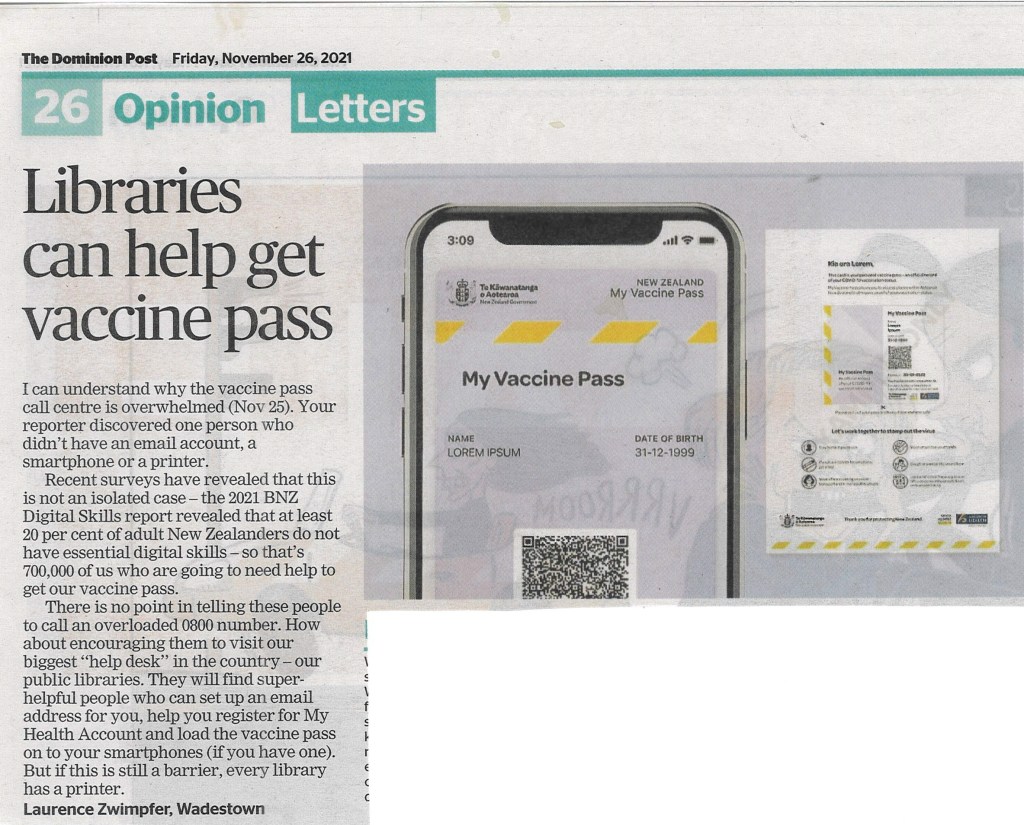
It was quickly evident that the Government’s backup plan to use the special 0800 number for people without digital access to request a Vaccine Pass was not going to work, with 70,000 requests backlogged. I was so disappointed with the negative stories emerging that I sent a letter to the editor of the Dominion Post on 26 November pointing out how public libraries (as the biggest ‘helpdesk’ in the country) could help.

And then the bombshell on 2 December to learn that some Councils had ruled that only people who could show their Vaccine Passes were permitted access to their libraries and other public facilities. A sort of catch-22; how could libraries help people get their passes if they had to have one to enter? Well done Clutha District Council, Waitaki District Council, Timaru District Council, Waimate District Council, Marlborough District Council, Upper Hutt City Council, South Taranaki District Council and Whanganui District Council, to name just a few who ruled in favour of remaining open to everyone, so that people could get the help they needed to get their passes.

But we still have a lot of work to do; at the time the new traffic light system came into effect on 3 December over 800,000 people who were fully vaccinated had not downloaded their Vaccine Passes.

We strongly encourage all our Stepping UP partners to provide ongoing support to help everyone in their communities get access to their Vaccine Pass and be able to enjoy the new freedoms that come with the Covid traffic light system.