Yes, it’s Jump stocktake time again

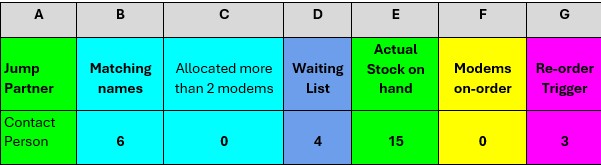
Each year we ask all our Jump partners to do a stocktake of their Jump modems to help us start the new year with a clean slate. If your Jump stock matches the number in cell E2 of your Jump GSheet, please send us a short email confirming this (jump@diaa.nz). If you don’t know how to access your GSheet, send us an email and we’ll remind you.

Check the top few lines of your GSheet – it should look something like this:

If there is a mismatch with your ‘actual stock on hand’, please email us the IMEI numbers (the numbers beginning with 8668, 8670, 8629, 8605 or 8664) for the ones you are holding and we’ll get your Gsheet back in order.

You will recall that we use the stock data in the GSheet to generate and prioritise new orders, so it is really important to keep these aligned.

Please also check that we have the correct contact name in cell A2 – this is the person we send new modem supplies to. If this is not correct please email us with the new contact person – name, email and contact phone number.

We would like you to confirm these details before Christmas; to help you with this, you might get a call from Georgia or Tori, our two Jump helpers (like Santa’s Christmas Elves).

And one other thing – we know some partners just never seem to be able to find the time to complete Modem Returns forms when a faulty modem is returned. So when you are doing your stocktake, please take a note of any old modems cluttering your cupboards and unsuitable for re-issue, we’ll send you a courier label to recover them. Just tell us the size of the box you will be using so we can get the courier charges right. Or if it is just one or two pesky modems, we can send you a return courier bag.

Martha wins the Prize!

Our hats off to Martha Manaena at REAP Wairarapa for bringing to our notice an interesting anomoly. She was trying to issue a new Jump modem and discovered it had the same IMEI number as one she had issued some time ago. To make matters worse, the modem had no Broadband sticker!

After a quick look in the box, she discovered the wayward broadband sticker attached to the inside of the box as many others have done during the last six months – this happens when the modems are thrust into the box too forcefully and the transparent broadband sticker decides to attach itself to the side of the box – remember, I raised this issue some months ago.

But modems with the same IMEI number??? This was news to me until I put on my thinking cap. Of course there would be modems with the same IMEI number. We have been using refurbished modems for the last 6 months and of course, a refurbished modem will have the same IMEI number as one that has been previously issued. The IMEI number is assigned by the manufacturer and relates to the modem hardware, not the Skinny internet connection.

There’s always a ‘good news’ side to the story. The IMEI number is something that we (DIAA) use to monitor modem supplies, but this is not relevant to Skinny – they rely on the Broadband number and Verification code, the two bits of information on the troublesome transparent sticker that sometime detaches itself.

So well done, Martha, for being the first person to notice this apparent anomoly, or at least the first person to raise it with me!

Where are the courier bags for returning faulty modems?

I am well overdue for a blog post on this topic. This is now the second most frequently asked question by Jump partners. What is the most frequently asked question you might wonder (scroll to the bottom to find the answer).

Back to the main topic of this post – some partners have been waiting for more than four weeks to get a return courier bag. The good news is that there is no great mystery here – it is simply a workload issue. Our goal is to get these to you so they are off your hands within 10 days of lodging a Modem Returns form, but that has been impossible over the last four weeks.

Our DIAA team has been a tiny bit preoccupied during the last month launching three new Digi-Coach programmes in the Waikato, Northland and last week in The Top of the South Island. Next week we are in the Central North Island and a week later in Wellington. With five new Digi-Coach cohorts in operation, that means 50 new Jump Specialists become available in libraries and community organisations throughout these regions five days a week for the 12-week work placements. Take a look at the stunning impact videos featuring Digi-Coaches in the Wellington region during the pilot programme earlier this year.

BUT, I digress. The really good news for return courier bags is that all partners should receive their bags this week. We had 50 on the courier yesterday and we are expecting the remaining 30 or 40 to be out the door this week. We have a new cunning plan to keep on top of this in the future and avoid such a huge backlog.

This has also impacted updates to your Gsheets for delinked modems. Normally these updates happen at least weekly, but they have suffered the same fate as the return bags. This is not such a problem, as partners receive a direct email notification from the Skinny team whenever a modem is delinked and reset for re-issue. So you don’t have to wait until your GSheets are updated before you issue delinked modems. They (your Gsheets) will catch up eventually, as this impacts your stock levels.

And the answer to the most common question is ‘When am I getting more modems? The answer to this question is much more complicated and varies week by week. But as some partners will have noticed, we have now exhausted supplies of the refurbished Smart modems and the latest shipment of over 700 modems was mainly the new Futura modems. The backlog of orders has reduced to 1600, which is the best it has been for most of this year.

From courier bags to modem supplies, the road ahead is looking brighter.

Hit ‘Pause’ – Possible provisioning problem with new Futura Modems

60 Jump partners were the first to receive the new Futura modems this week. But as these partners are discovering, the modems appear to have been provisioned for Standard Skinny, not Jump.

Now we don’t know how widespread this is and whether all 732 modems are affected, but it would be prudent to hit ‘pause’ in issuing these. My rule of thumb is that when more than one partner reports a problem, we pause sign-ups until the problem is understood and resolved.

I’ll provide an update when we know more.

Customers needing replacement modems – it’s your call

Clarifying the Process for Replacement Jump Modems

We regularly receive reports from partners about Jump customers requesting replacement modems — often because their modem has been lost or stolen, or because they’ve been referred by the Skinny Care Team. These situations can put pressure on your staff, especially when customers arrive unannounced and expect an immediate replacement. In some cases, they may become quite insistent or even stroppy.

However, Jump partners do not have the tools or access needed to issue replacement modems on the spot. That’s why our recommended process is for all replacement modem requests to be directed to the Skinny Care Team (0800 475 4669).

The Skinny Care Team has the systems in place to:

  • Check whether a modem is genuinely faulty.
  • Verify the customer’s identity and Jump status.
  • Complete the required Modem Returns form, which triggers the modem de-linking process and a request for DIAA to courier a replacement.

Once the form is submitted:

  • We (DIAA) arrange for a replacement modem to be sent directly to the customer.
  • We also include a prepaid courier bag for returning the faulty modem.
  • The de-linking process takes a few days, ensuring that by the time the new modem arrives, the customer’s account is ready to be activated.

Lost or Stolen Modems

If a modem has been lost or stolen, partners must not issue a replacement under any circumstance. The customer must contact the Skinny Care Team directly to report the issue and begin the verification process.

Incorrect Information from Skinny Care

It seems that part of the confusion arises when Skinny Care agents mistakenly direct customers to Jump partners for replacements. Please note: Skinny agents should never refer customers to partners for replacement modems. If they confirm the modem is faulty, they should complete the Modem Returns form instead.

Managing Customer Expectations

We know it’s not always easy to turn customers away — especially when they show up unannounced. That’s why we strongly encourage all partners to:

  • Clearly communicate to your community the type of support you offer.
  • Decide whether Jump support is provided via:
    • Drop-in sessions,
    • Set times during the day/week,
    • Appointment only.
  • Avoid providing support during staff lunch breaks (12–2pm) or during busy periods such as school holidays, when other programmes may take priority.

Optional Modem Replacement by Partners

If you do choose to issue a replacement modem (e.g., if you have one available and have time to assist), that’s entirely up to you. While this is outside our standard process, we’re happy to support you if you have the capacity.

Just ensure that customers understand:

This is a back-end procedure that cannot be fast-tracked — not by delivery partners, the Skinny Care Team, or DIAA.

The de-linking process cannot happen instantly.

Is there still a problem with Jump modems not being properly de-linked?

Partners trying to reissue returned modems during the last 3 months have experienced numerous problems when they try to use these ‘de-linked’ modems, only to discover they are still linked to the previous owner’s email.

I appreciate that this has been extremely frustrating and appears to have resulted in partners feeling a bit nervous about re-issuing de-linked modems.

We think the problem is because of staff changes in the Skinny Jump team and misunderstandings about the de-linking and resetting processes. We appreciate that there has also been confusion about exactly what is required to de-link, reset and reprovision a Jump modem.

After much discussion between the Jump team in Spark and the Skinny support team, a new de-linking process was introduced on 24 March 2025 that we believe will solve the problem.

We have also used this as an opportunity to be very clear about what is meant by the terms used to describe this process. It is unfortunate that the language used in the new November 2024 Jump Partner Guide is still a bit confusing.

The umbrella term to be used for all returned modems is now “de-linking”, whether the modem is to be reused or sent for repair.

This involves completely deleting the customer account linked to the modem, which both frees up the modem for re-use as well as releasing the customer’s email for reuse should the customer wish to set up a replacement modem.

In the past, we have used the terms “resetting” and “reprovisioning” to explain how delinked modems are readied for reissue with a 35GB start-up data plan, but we are going to stop using these terms, as they are just sub-sets of the de-linking process.

Every modem that is delinked is automatically reprovisioned with a new 35GB start-up data plan, whether the modem is for reuse or repair.

The only exception is modems that are reported as ‘lost’ or ‘stolen’; these are permanently blocked.

The good news is that the new process seems to be working well, with timely notifications to partners as well as excellent tracking of the various components of the de-linking process. The not so good news is that the delinking process is taking a bit longer – up to 3 or 4 days. But in our view if this results in a more robust process it is well worth the wait.

We are going to be watching very closely any modems that have been delinked since 24 March to make sure the new process is working as expected. Partners holding modems that have been reset before this date are welcome to submit them again if you have any concerns that they might not have been de-linked properly.

Footnote: You might also be wondering what happens to any credit on a customer’s account when their old account is deleted. The Skinny team records the amount of this credit on the customer card, so that when a customer calls up and asks for the credit to be transferred to their new account, they can arrange this.

Reburbished Jump modems making their way back to customers

You might be wondering what happens to all those faulty modems you send back to us for repair. Some are beyond repair and are extracted for recycling, but others are returned to ‘as new’ and are now being distributed with regular shipments to partners. The first batch of 173 refurbished Smart modems were distributed in recent shipments.

You might notice marks on the modem case or other slight imperfections, but don’t be fooled, the inside electronics are in top working condition. Some of us think refurbished modems are in even better condition than new ones. Each has been individually repaired and tested while new ones are often sample tested, resulting in some being faulty right out of the box.

So if you spot a refurbished Jump modem, do tell your customer how lucky they are to not only receive a unit that has been individually tested but also for making a positive contribution to the environment.

Swapping Jump Modem SIMs is not the Solution!

We had two situations this week where Jump customers with faulty modems thought it might be a good idea to take the SIM card from their faulty modem and put it in their new replacement modem. This would mean they didn’t have to set up a new Jump account and link their new modem.

My first thought was that these customers might be onto something we hadn’t really considered since the beginning of the Jump programme, so we did a bit more investigation.

First of all we discovered not all Jump modems use the same size SIM card.

The Standard or Mini-SIM (also known as 2FF) measures 25 x 15 x 0.76 mm and is typically used in larger devices. Most portable devices such as today’s smartphones currently use a Micro-SIM measuring 15 x 12 x0.76 mm or a Nano-SIM, measuring 12.3 x 8.3 x 0.76mm. SIM cards are typically provided in sets of three, combining the Standard SIM (Mini-SIM), the Micro-SIM and Nano-SIM into one – it’s called the Triple SIM (or Tri-SIM). Users simply pop out the required size for their device.

We then checked out what size SIM is used in Jump modems and this is what we discovered: B315, Smart and Futura modems use a Micro-SIM, while the B618 uses a Nano-SIM.

Unaware of these differences, our enterprising Jump customer extracted his Nano-SIM from his B618 and inserted it into his new Smart Modem, and yes, you guessed it – the Nano-SIM simply disappeared inside his modem! So he now became the proud owner of a brand new faulty modem!

So that was our first lesson – never inset a Nano-SIM into a device expecting a Micro-SIM.

Undeterred, we followed this up with Skinny Jump specialists in Spark to get their view on this practice of swapping SIMS. They advised us that technically a Jump-provisioned SIM card can be swapped into new hardware (provided of course the SIM cards are the same size). BUT, and there is a big BUT, swapping SIMS might solve one problem but generate another. With a swapped SIM, the details printed on the modem sticker (broadband number and verification code) no longer match the SIM in the modem. So when it comes to reporting a fault and getting support from the Skinny Care Team, this creates huge confusion.

So our second lesson was simply to never swap a SIM.

What do I do with a returned modem that isn’t a Skinny Jump one?

I have had two questions from partners about this so far this week (and it’s only Wednesday), so that calls for a blog post!

The challenge that partners are facing is that the same physical modem is used by Spark and Skinny for a range of different services, some of which are wireless and others are for landline (fibre) connections. So it not always easy to identify which ones have been provisioned for Skinny Jump.

My advice is to lodge ALL returned modems that look like a Skinny Jump modem through our Modem Returns Process. The Skinny team will advise us whether the modem has been provisioned for Jump or not.

Any ‘non-Jump’ modems will then be treated as ‘faulty’ and this will result in us sending you a recovery courier bag. We return these to CEVA, the company that manages the supply of modems, and it is their job to arrange the repair of faulty Jump modems or the transfer of other modems to the right party, or in case of very old or damaged modems, they would most likely be sent for recycling.

Why we ask you to return all unwanted modems

During the week a partner notified us that a Skinny Jump modem had been returned in a very poor condition and questioned whether it was worth the cost of a courier package to return it.

While the primary motivation in recovering unwanted modems is to refurbish them so that they can be used for another family, equally important is the need to keep electronic waste out of landfills.

I am not sure how the partner who raised this issue was planning to dispose of the modem, but New Zealand is still facing many challenges in having robust ways for us to dispose of our e-waste. There are three particular challenges:

  1. where do you take your e-waste;
  2. what does the organisation accepting your e-waste do with it; and
  3. who pays?

There is a solution, called Product Stewardship, were suppliers of electronic goods are required to not only pay for the recovery and processing of e-waste, but also meet robust environmental standards for the processing and disposal of recycled materials.

Most manufacturers of electronic goods are happy to pay these costs; they simply add recycling costs to the price of new goods, so the consumer actually pays. But, in countries where they do this, they insist that governments create mandatory product stewardship regulations. This ensures a level playing field for all suppliers. And this is what is missing in New Zealand. There have been calls for this for nearly 20 years, but successive governments have failed to get this across the line.

The previous government made some progress and there are hopes we could see mandatory e-waste product stewardship schemes in operation within the next couple of years.

In the meantime, we rely on suppliers to take responsibility on a voluntary basis. Some already do this, but it is not that straightforward when most of the electrical and electronic equipment used in New Zealand is imported. We then rely on local equipment distributors or local authorities to assist with recovery and recycling.

Spark NZ has made a commitment to take responsibility for the recovery and refurbishment or recycling of all Skinny Jump modems. They can then ensure that no unwanted equipment ends up in landfills or with recyclers who do not comply with good environmental practices.

So, yes, it is worth paying the courier charges to recover all unwanted modems.